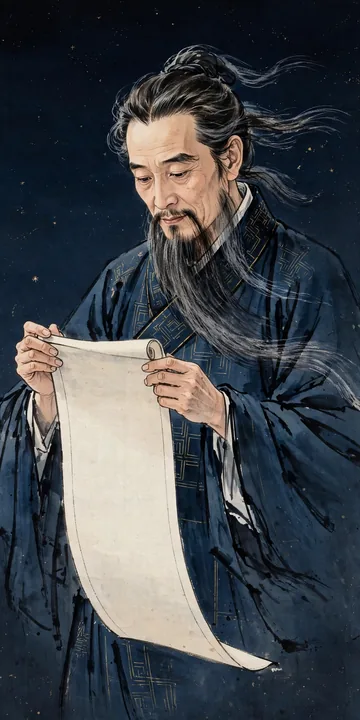


Zhang Taiyan
Zhang Taiyan
Modern Master of Chinese Classical Learning · Revolutionary
1869-01-12(7th year of the Tongzhi reign (Qing), 11th lunar month, day 30)~ 1936-06-14
Born in Yuhang, Zhejiang
Three-Pillar ChartBirth hour unknown — three pillars only
Year Pillar
戊辰
Element Earth · Earth
NaYin Great Forest Wood
Ten Gods Direct Officer
Month Pillar
乙丑
Element Wood · Earth
NaYin Sea Metal
Ten Gods Eating God
Day Pillar
癸卯
Element Water · Wood
NaYin Gold Foil Metal
Ten Gods Day Master
Hour Pillar
??
Hour unknown
Not cast
Day Master
癸Water
Element distribution (three-pillar count)
Earth 3, Wood 2, Water 1, Fire 0, Metal 0
Chart computed by the MoZhu engine (lunar-javascript); without the hour pillar, luck pillars and yearly cycles can't fully unfold.
Case Review
Original writing · hindsight review · anchored in known history, viewed through chart structure
Gui (癸) Water is the Water of rain and dew, signifying wisdom, with Direct Officer and Eating God revealed in the year and month and Earth appearing three times. Looking back on the life of Zhang Taiyan, a master of classical Chinese learning: the eloquence of his “Letter Refuting Kang Youwei on Revolution” and the scholarship of his Critical Essays on National Heritage mirror “Eating God displaying its brilliance.” Direct Officer signifies the integrity with which, in his early years, he was “hunted seven times and jailed three times” without changing his resolve.
Earth controls Water threefold. His lifelong experience of suppression (writing in prison, lecturing in his later years) can be observed in hindsight through the structure of “heavy Earth muddying the Water, wisdom trapped.” Yet Wood loosens Earth (Yimao 乙卯): in his later years he founded the Zhang Society for National Learning to nurture younger scholars, a footnote to Wood opening the way.
This is a cultural retrospective at the level of three pillars, not a fatalistic judgment.
Birth date source:Chinese Wikipedia: “Zhang Binglin”(cross-checked with public records; bio is an original summary)
This case is for traditional-culture study only, not a judgment of any historical figure; schools of interpretation differ, and these conclusions claim no exclusive truth.